
Zero Trust Was Designed for Humans, not Agents
In 2009, Google got breached. The attack, later called Operation Aurora, came in through a corporate VPN that until that moment had been the foundation of how enterprises kept attackers out. The breach killed an assumption that had organized network security for a generation: that the inside of the network was a trusted place. The outside was where threats lived. The job of security was to keep the wall strong.
Google’s response was BeyondCorp. The principle was simple and structural. The network is hostile, including the inside of the network. Every request gets verified. Every user gets authenticated continuously. Every device gets attested. There is no implicit trust based on where the request came from. The wall went away, and the verification moved to every interaction.
This idea became zero trust. Forrester named it in 2010. Google productized it. NIST codified it in SP 800-207 in 2020. The White House mandated it for federal agencies in 2022. Every serious CISO has been deploying some version of it for the past five years. The model works. It is the right answer to the question it was asked.
The question it was asked is about humans and workloads. Agents are a different question.
This is the part of the agent infrastructure conversation that has been moving slowly. Zero trust has fifteen years of operational refinement, written into products, frameworks, and procurement requirements. The temptation is to assume that whatever zero trust was doing for users and services can extend without modification to the agents now running in production. The temptation is wrong, and the places where it breaks tell you what an agent-native zero-trust model has to provide.
AGTP is what that model looks like when somebody builds it.
What zero trust assumes
Strip zero trust down to its operating assumptions, and the human-and-workload shape becomes visible.
The model assumes the actor making a request has an identity provider that can vouch for it in real time. Humans have an IdP with SSO, MFA, and credential rotation. Workloads have SPIFFE, mTLS with certificates issued from a known CA, or short-lived credentials from a metadata service. In both cases, the verification step is “ask the identity provider whether this caller is still legitimate” and the IdP gives a current answer.
The model assumes least-privilege access can be enforced by scoping tokens to specific resources at the moment of access. Humans get OAuth scopes during an authorization flow. Workloads get policy-bound credentials with explicit resource grants. The scope lives in the token. The application enforces it.
The model assumes continuous verification through telemetry. Sessions get re-checked. Tokens get refreshed. Anomaly detection runs against the stream of accesses, and breach assumptions mean any session can be revoked at any time. The verification is continuous because the actor is continuously present.
The model assumes microsegmentation can be enforced at the network layer. Traffic between zones gets inspected. Identity at the segment boundary is verifiable through certificates the segment manager understands. Lateral movement is what zero trust was built to stop.
These assumptions work for the actor types zero trust was designed for. They start to bend when the actor is an agent.
Where the model bends
An agent has no identity provider in the traditional sense. The provider that “vouches” for the agent is the governance platform that signed its Genesis at activation, which is structurally different from an IdP that authenticates a session in real time. Agent identity is more like a passport (issued once, valid for the entity’s lifetime, derived from a permanent record) than like a session token (issued continuously, valid briefly, tied to an active login). Asking “is this agent legitimate” looks more like asking “is this passport authentic” than like asking “is this user logged in.” The verification mechanism has to change.
An agent has no MFA device. There is no second factor an agent can be challenged for, no phone to push a notification to, no hardware key to plug in. The factors of authentication for an agent are different: cryptographic proof of the Genesis, organizational binding to an owner, freshness of the manifest in the registry, currency of the certificate that binds Agent-ID to TLS. Multi-factor for agents means multi-source for verification, rather than multi-device for the user.
An agent has no session in the human sense. An agent might run for hours, pause overnight, resume in a different context, hand off to another agent halfway through a task. The “session” zero trust was designed around assumes a human at a keyboard. Agents need state and continuity primitives that work for runtime that crosses sessions and crosses organizations.
An agent crosses organizational boundaries by design. Zero trust microsegmentation assumes the segment boundary is inside an organization, with one operator running the policy on both sides. Agents at Company A delegating to agents at Company B requires policy enforcement at a boundary neither operator controls alone. The microsegmentation has to live at the protocol layer, because no single segment manager has visibility into both sides.
An agent has accountability that points at multiple parties. A human request has one principal: the user. An agent request has three: the agent that acted, the owner accountable for the agent, and the principal whose authority the agent was exercising. Zero trust frameworks have no native primitive for representing all three on the same request, so each system invents its own way to encode the extra parties, and the encodings fail to compose across organizations.
These bends are real. They are also addressable. The fix is to take the zero trust principles seriously and produce primitives that satisfy them for the actor type that triggered the bend.
What AGTP does for zero trust
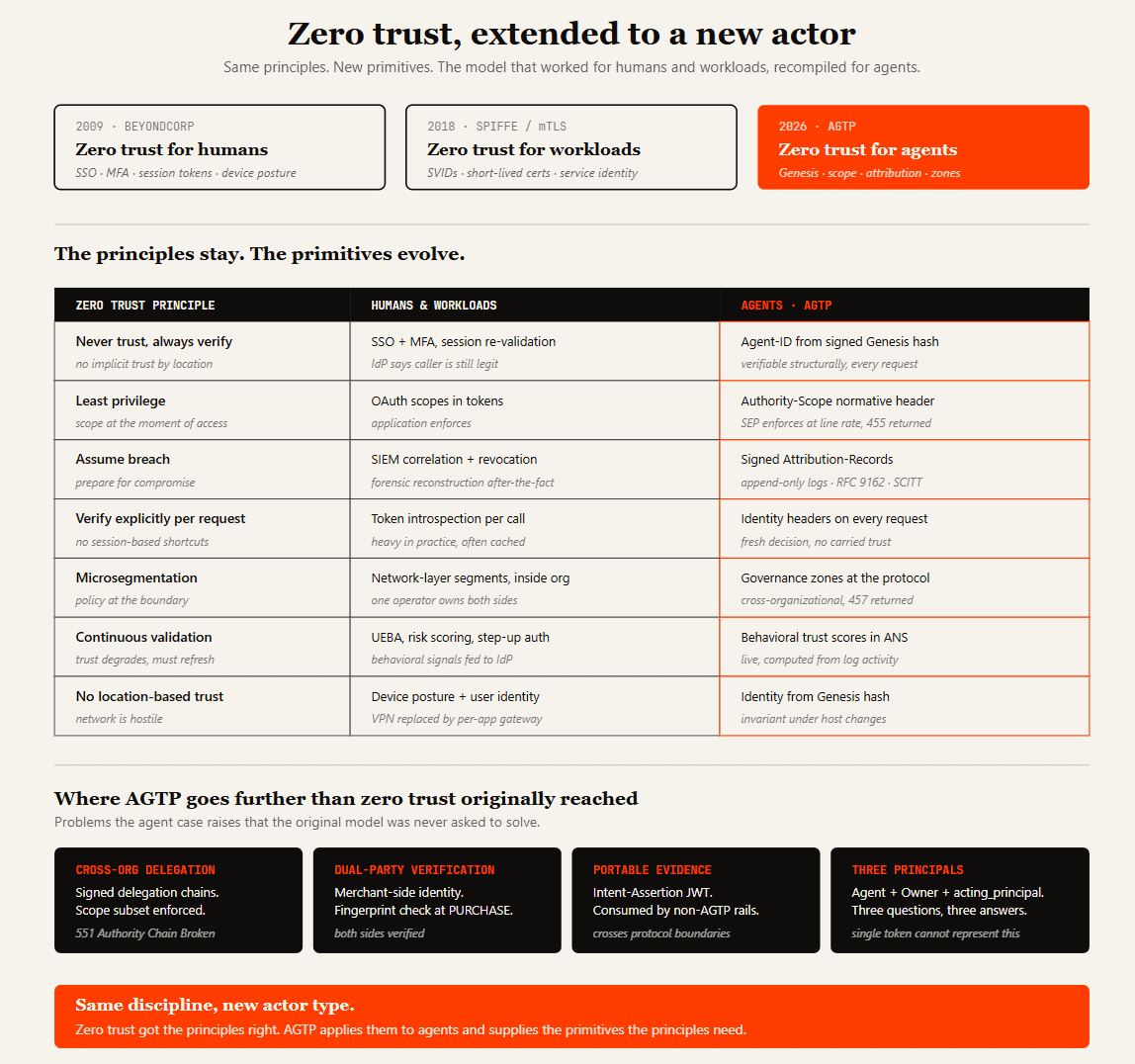
AGTP applies the zero trust principles to agent traffic by making them protocol properties. Each principle maps to a specific AGTP construct.
Never trust, always verify. Every AGTP request carries Agent-ID, Owner-ID, and Authority-Scope as wire-level headers. Identity is cryptographically anchored in the Agent Genesis, a signed origin document whose 256-bit hash is the Agent-ID. The Genesis-issuer trust path is verifiable through one of three documented routes: DNS-anchored, log-anchored, or hybrid. Any receiver of an AGTP request can verify the agent’s identity claim without trusting the network, the host, or the hosting domain. Verification is structural rather than negotiated per session.
Least privilege. Authority-Scope is a normative header that compliant servers MUST parse on every request, returning 455 Scope Violation for any method that exceeds the declared scope. The scope is expressed in domain:action form drawn from a reserved registry. Scope Enforcement Points enforce at line rate, before the application sees the request. Least privilege moves from an application-layer convention to a wire-level guarantee.
Assume breach. Every consequential AGTP interaction produces an Attribution-Record bound to the responding agent’s identity, the request hash, and the response status. Records are signed and written to append-only transparency logs aligned with RFC 9162 and SCITT (RFC 9943). When a breach happens, the forensic substrate exists already. Incident response queries the log instead of reconstructing from per-framework application logs.
Verify explicitly, every request. AGTP carries verification material on every request rather than relying on session-based trust. Agent-ID is present. Owner-ID is present. Authority-Scope is present. The verifying server has everything it needs to make a fresh decision on every call, with no implicit trust carried forward from prior requests in the same connection.
Microsegmentation. Governance zones (zone:eu-gdpr, zone:us-healthcare, zone:retail-verified) are first-class. Agents are registered in zones. Requests carry AGTP-Zone-ID headers. SEPs enforce zone boundaries at line rate, returning 457 Zone Violation for cross-zone traffic that policy forbids. Microsegmentation works across organizational boundaries because the protocol carries the zone semantics and any AGTP-aware SEP can read them.
Continuous validation. Behavioral trust scores are computed from signed Attribution-Records and surfaced in ANS results. Discovery responses carry live behavioral data, so an agent’s reputation reflects current behavior rather than the credentials it had at registration. Trust is dynamic at the protocol layer.
No location-based trust. Agent-ID is derived from the Genesis hash. It is invariant under hosting changes, domain rotations, and operator migrations. An agent moving between hosts keeps the same canonical identity. A spoofed agent at a familiar hostname produces a hash mismatch the verifier catches. Trust is bound to identity rather than to network location.
Identity-based access control. Authority-Scope tokens are bound to Agent-ID via certificate commitments in the AGTP-CERT extension. SEPs that read the certificate at session establishment can enforce scope at O(1) cost per request, because the commitment is parsed once and checked thereafter. Access decisions are tied to verified identity rather than to where the request appears to come from.
The pattern is the same one zero trust applied to humans and workloads, recompiled for the new actor type. Verification is wire-level. Scope is declared and enforced. Audit is structural. Boundaries are protocol-level. Trust is identity-bound and continuously evaluated. The principles stay intact. The primitives change to fit the actor.
Where AGTP goes further
There are places where the agent case demands more than zero trust traditionally delivers, and AGTP supplies the additional structure.
Cross-organization delegation has been the hardest unsolved problem in distributed trust. Zero trust handles trust inside an organization. AGTP handles trust across organizational boundaries through signed delegation chains, where each hop’s scope is a strict subset of the previous hop’s scope and chain breaks return 551 Authority Chain Broken. The protocol enforces a property no application layer can reliably enforce: the agent receiving a delegated request cannot use authority the delegating agent lacked.
Counterparty verification at commerce time goes beyond what zero trust typically addresses. AGTP’s merchant identity layer verifies the receiving party of a purchase with the same rigor as the initiating party. The Merchant-Manifest-Fingerprint catches endpoint redirection by binding the manifest the agent verified to the manifest the server actually presents. Both sides of a commercial transaction get identified, and the dual-party Attribution-Record gives downstream systems a complete artifact.
Portable evidence across protocols closes a gap zero trust has historically struggled with. The Intent-Assertion JWT is a signed proof of principal-authorized intent that non-AGTP systems can consume directly. Card networks, payment processors, regulators, and dispute resolvers verify the JWT signature against a published key without needing to speak AGTP. This is the bridge between AGTP-native infrastructure and the institutional fabric that already exists.
Reputation as a verifiable property closes another gap. Zero trust says “verify the caller.” AGTP says “verify the caller and also surface what the caller has done across the network.” Behavioral trust scores in ANS results give downstream decisions a richer input than identity alone. Selecting an agent for a delegation becomes selecting an agent for accountability, with the track record visible at the moment of selection.
These are extensions of zero trust rather than departures from it. Zero trust got the principles right. AGTP applies the principles to a new category of actor and supplies the primitives the principles need to operate.
The model the moment needs
There is a practical observation worth ending on. The agent economy is going to be deployed inside organizations that have spent the past decade adopting zero trust. The procurement requirements are written. The security frameworks are mapped. The compliance language is settled. Anything new has to compose with this work rather than replace it.
AGTP composes. The zero trust principles are preserved. The verification model gets stronger. The audit substrate gets cleaner. The microsegmentation extends to organizational boundaries that zero trust historically failed to cross. The result is a security posture compatible with what enterprises have already built and capable of what enterprises now need.
The CISO deploying AGTP is extending an existing investment rather than abandoning one. Zero trust said never trust, always verify. AGTP says: for agents, here is what verification actually looks like at the wire. The agent’s Genesis is signed. The scope is declared. The attribution is recorded. The zone is enforced. The trust score is live. The certificate binds the identity to the transport. Every interaction is verifiable. No session-based shortcuts. No location-based assumptions. Every request stands on its own.
Zero trust was designed for humans and workloads. It worked for what it was designed for. The agent economy needs the same discipline applied to a new actor type, and AGTP is what that application looks like. The principles stay. The primitives evolve. The wall went away again, and the verification moved to every interaction.
The model the moment needs is zero trust extended to agents. The protocol the model needs is one that carries the extension natively.
If you find this content valuable, please share it with your network.
Follow me for daily insights.
Book me to speak at your next event.
Start managing your agents for free.
Chris Hood is an AI strategist and author of the #1 Amazon Best Seller Infailible and Customer Transformation, and has been recognized as one of the Top 30 Global Gurus for Customer Experience. His latest book, Unmapping Customer Journeys, is available now!