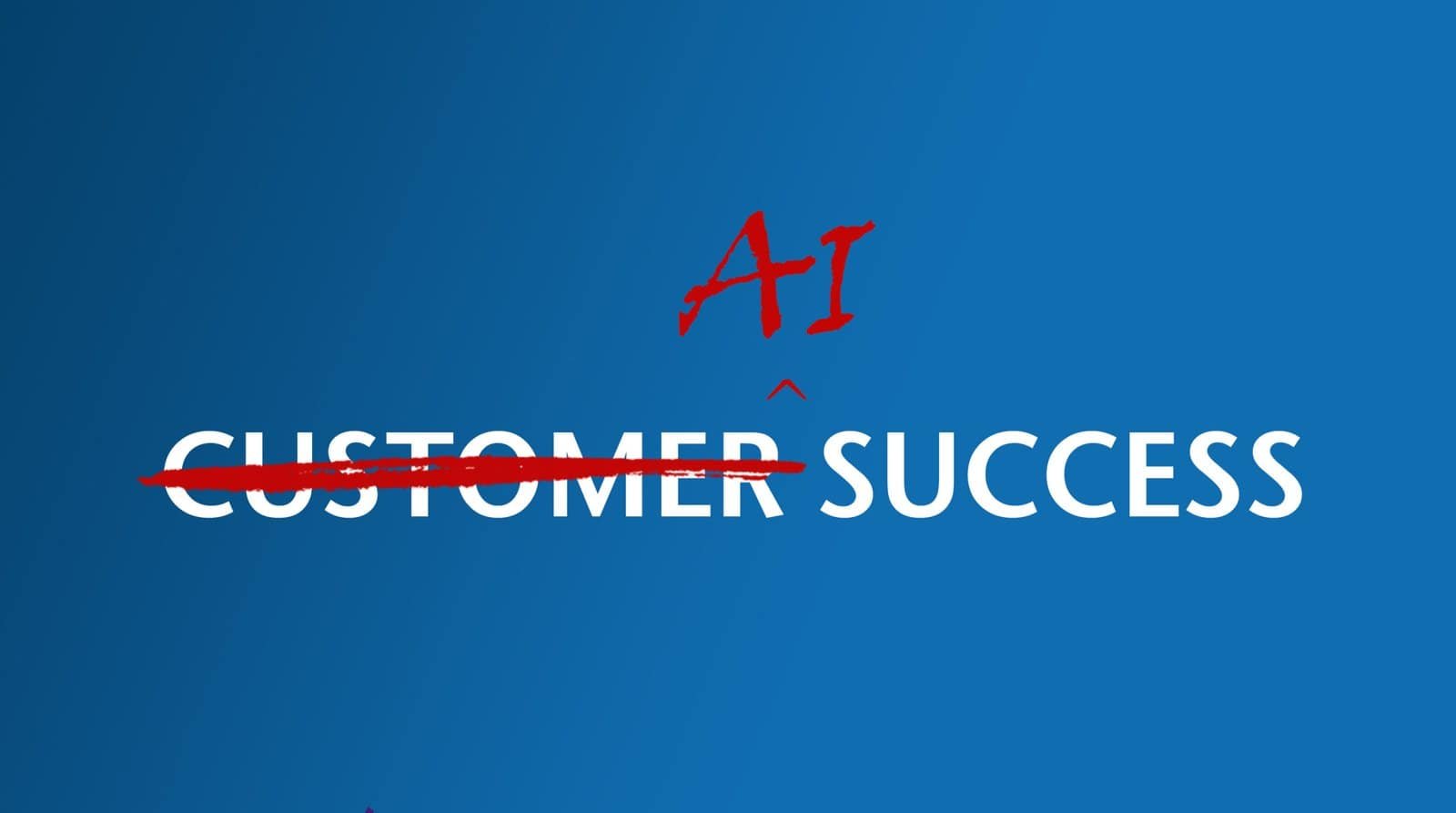
Let’s Just Call It Cust… AI Success
These are thrilling times for customer success. After years of slow, unglamorous progress, the profession is finally evolving to a point of recognition. Fresh inspiration is flooding the boardrooms. Innovation is everywhere. Executives who could never be persuaded to sit through a customer review are now leading the strategy offsites themselves, sleeves rolled up, and at the front of the line.
Budgets have appeared. Roadmaps have been redrawn. Entire operating models are being reimagined, and for the first time anyone can remember, the function has the CEO’s full attention.
The discipline has even earned a new name to match its new ambitions. AI Success.
You may notice a word missing in this rebranding effort.
The customers have noticed too.
The previous role had one function, so obvious that even the title declared what needed to happen: Make the customer successful. Yet despite the simplicity of both the term and the mission, it couldn’t withstand the onslaught of the newest shiny object.
The backlash has been swift and, in its way, just as instructive. My feed is full of customer success voices condemning Gainsight for abandoning the human touch. Some do it from profiles that describe their work as AI-first customer success. They ridicule Gainsight’s strategy, yet still embrace the same concepts in their own headlines.
You cannot be AI-first and customer-first.
So here is the question nobody in the industry seems eager to answer. When did we decide that AI was more important than serving the customer?
A proud tradition
In fairness to AI, it did not start this. AI Success is the function’s second rebrand.
Before it became Sales Success, CSMs were handed renewal quotas, and health scores were quietly rebuilt to forecast revenue. Back then, I said that if customer success were about sales, we would call it Sales Success. The industry didn’t listen, and the focus on the customer kept declining.
Both brandings do the same job. They point at what the company wants, with little concern for what it might cost.
So AI did not demote the customer. That decision was made years ago with sales quotas. AI simply arrived with the budget to finish the job.
A pioneer leads the way
No one has embraced the new era more enthusiastically than Gainsight. This week, Investing.com reported that the company cut roughly 270 roles as it “refinds” itself around AI agents. The CEO confirmed the layoffs, declined to confirm the number, and wrote warmly about the teammates the company was saying goodbye to. That warmth didn’t extend to keeping them.
The new model is a marvel of clarity. Every customer gets one accountable “Outcome Executive.” If you are a large account, that is a person. If you are not, it is an AI agent, and presumably a very accountable one.
Skeptics might assume the company had no choice. Happily, it did. By the CEO’s own account, the core business is highly profitable. Nobody was drowning. They just preferred a different boat.
It is a fitting achievement for a company that spent more than a decade positioning itself as the founding voice of customer success. The self-appointed conscience of the profession has studied its own customers and found that software can handle most of them. It is a confident verdict from a company whose definition of customer engagement no longer requires anyone to engage.
The consultants confirm the good news
For anyone worried about the profession’s health, help is on the way. Days before Gainsight’s announcement, Bain & Company published The Rebirth of Customer Success. Rebirth is a generous word. It implies a death first, and on that point I suspect we agree more than Bain intended.
The diagnosis: net revenue retention at public software companies has slipped from about 115% to about 107%, and CS leaders struggle to prove their return. The cure: one accountable owner, pooled specialists, and AI agents on every account. Bain reports that around 70% of CS leaders still aren’t using AI meaningfully, and doing so will change their revenue potential.
Bain does describe the function’s purpose as helping customers realize value. For a company with $500 million in recurring revenue, one point of NRR is worth about $25 million over five years. It is a compelling number. It is also the vendor’s number.
So customer success may live, provided it uses AI. Whether the function can be automated in time is the FOMO. Whether it serves the customer is clearly illusory.
A triumph of measurement
The new era has also been wonderful for metrics. Researchers have a word for what is happening. Surrogation is a psychological and cognitive phenomenon where a metric, proxy, or KPI replaces the original strategic goal or abstract construct it was meant to measure. Wells Fargo wanted long-term customer relationships, measured cross-selling, and ended up opening accounts for people who had never asked for them. The metric was thrilling.
Customer success has reached this point many times, with every new “magical metric” intended to disguise their business-first, not customer-first, mindset. Health scores and Retention metrics. Heck, even QBRs are designed to pat the business on its back for having the right internal metrics. Gainsight now calls itself the retention-as-a-service company, which is refreshingly honest, but no customer in history has woken up hoping to be retained.
AI has given us even better numbers to admire. Accounts covered by an agent. Tickets deflected. Conversations contained, a word normally reserved for spills and outbreaks. Headcount per dollar of ARR. The dashboards have never looked healthier. Whether the customer got what they paid for is, regrettably, outside the dashboard’s scope.
Hence the new name. AI Success is simply the only success every business currently cares about.
Without the party hat
So, in plain terms: customer success, as the name promised it, is dead. What is being built in its place is a retention department with AI.
AI can help. AI belongs wherever it gets a customer to their outcome faster. And sorry, no one is thinking that way. Businesses prefer to focus on reaching their internal outcomes faster.
The trouble is the order of operations. Start with what the customer is trying to achieve, then decide what a person does and what an agent does. The industry is running it backward, with great confidence and excellent slides.
Running it forward is not mysterious. Write down, at the sale, what the customer bought the product to do, in their words and with a date attached. “Close the books in five days instead of ten by June” is a goal. “Drive adoption” is not. Then put three numbers at the top of the dashboard: how many customers have reached that goal, how long it took them, and how many confirm it at renewal. Retention goes underneath, where a consequence belongs.
I have not seen that dashboard. Not on a board slide, not tied to anyone’s pay. If you run a team built on it, prove me wrong. Send it to me.
Nobody forced this. No regulator demanded it, and no customer petitioned for it. AI transformation looks great in a press release. A customer who quietly got what they paid for has never once been the subject of a keynote.
More companies will follow Gainsight. They will say it is about outcomes, but really, it’s about bad decisions and not caring about their customers.
Ask them, and ask yourself:
- In your last board deck, which came first: the AI metrics or the customer outcome metrics?
- When you moved accounts to an agent, did you ask those customers, or did you inform them?
- If the agent hits every target and the customer still fails, does anything on your dashboard turn red?
- Who, exactly, is your customer success team making successful?