
BadHost Was Inevitable. The Substrate Made It So.
On May 26, 2026, security researchers at X41 D-Sec and Secwest disclosed CVE-2026-48710. They called it BadHost. The vulnerability is a critical authentication bypass in the Starlette Python framework, the library that sits under FastAPI, vLLM, LiteLLM, Text Generation Inference, most OpenAI-compatible API proxies, and most MCP server implementations. Starlette ships roughly 325 million downloads a week. The bypass requires a single character in the HTTP Host header. A /, a ?, or a # placed where the parser treats it as a path delimiter will route an authenticated request to an endpoint the middleware thought it was protecting. Starlette 1.0.1 patches it. Thousands of operators are updating right now.
The patch is real, the response is competent, and the operators working tonight deserve a thank-you. This piece is about something else.
The more important story is what BadHost reveals about the foundation underneath every running AI agent in production today. The seams that produced this bug are the same seams the agent ecosystem has been building on for two years. The next bug like this is already inside the codebase, waiting for the right researcher to find it.
That sounds dramatic. It is just architecture.
A bug that lives in no single file
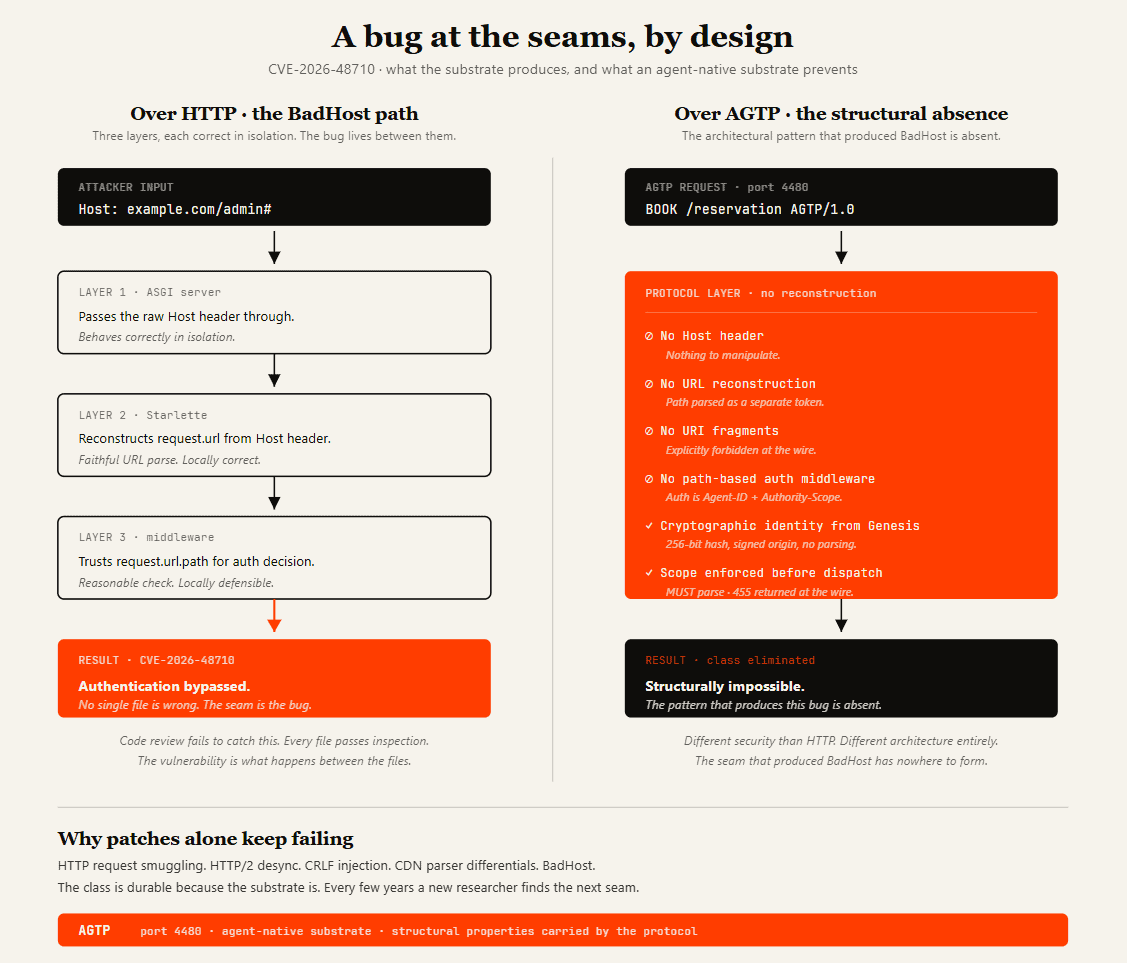
X41’s disclosure is precise about where the vulnerability lives: nowhere in particular, and everywhere at once. CVE-2026-48710 spans three independent layers, each of which behaves correctly in isolation.
The ASGI server passes the raw Host header through. Starlette uses that header to reconstruct request.url. Middleware authors trust that request.url.path is safe to use as the input to an authentication decision. No single component is wrong. The vulnerability is what happens at the seams between them, when a header value the ASGI server treated as opaque gets parsed by Starlette into a URL whose path the middleware then trusts.
This is the part worth sitting with. A vulnerability that lives at the seams of a stack is a vulnerability that careful code review will miss, because every file in the review passes inspection. The reviewer reads the ASGI implementation and sees correct header handling. The reviewer reads the Starlette URL reconstruction and sees a faithful parse. The reviewer reads the middleware and sees a reasonable authentication check. The bug is in none of those files. The bug is in how they are composed.
This is the signature failure mode of building agent infrastructure on a substrate designed for a different purpose. HTTP was built to retrieve hypertext documents from web servers, with humans typing URLs into browsers. It was never built to carry agents authenticating themselves to other agents across organizational boundaries. The Host header exists so a single server can host multiple websites, rather than so an agent can anchor cryptographic identity. When the agent ecosystem chose HTTP as the substrate, it inherited HTTP’s assumptions about who would be calling and why. BadHost is what those assumptions look like when they fail.
What agent traffic actually needs
Agent traffic has structural properties that HTTP was never asked to carry.
Agents need identity that survives delegation across organizational boundaries, where no single certificate authority spans all the parties involved. Agents need scope enforcement that runs before the application code does, because a request that exceeds the agent’s authority should be refused at the protocol layer rather than parsed, dispatched, and then reconsidered. Agents need attribution that cannot be omitted by a malicious implementation or forgotten by a busy one, because the regulatory environment (EU AI Act Article 12, the NIST AI RMF, ISO/IEC 42001) is converging on a requirement that the audit trail be a structural property of the system.
The standard response has been to add each of these as a convention on top of HTTP. Identity becomes a header. Scope becomes a token. Attribution becomes an entry the application writes to a log somewhere. Each addition is locally reasonable. Each addition treats the substrate as fixed and the missing properties as the application’s problem.
This is precisely the architecture that produced BadHost. Properties that should live in the protocol are pushed up into application middleware, and the middleware ends up trusting parser outputs from a library that trusts headers from a server that trusts bytes from the network. The trust chain has three hops, each one defensible, and the result is a bypass that requires one character.
Careful middleware authoring fails to fix this, because the problem is structural. A different middleware author with the same architecture would have produced an equivalent bug at the same seam. The seam is the bug. The next person reviewing it will see what the last person saw.
What AGTP does differently
The Agent Transfer Protocol, an IETF draft, makes the architectural commitment that agent traffic deserves a dedicated wire format on a dedicated port, with the structural properties of agent identity carried as protocol primitives rather than as application conventions.
AGTP runs on port 4480 with its own wire format. There is no Host header to manipulate, because the protocol avoids reconstructing URLs from headers. The request line carries the path directly, parsed as separate tokens before any dispatch occurs. URI fragments are explicitly forbidden at the wire layer, removing the entire class of parser-confusion bugs that BadHost exploited. The Canonical Agent-ID is a 256-bit hash of the Agent Genesis document. Identity is cryptographically derived from a signed origin record, never parsed from a header an attacker can shape. Authority-Scope is a normative header that compliant servers MUST parse on every request, returning a structured 455 Scope Violation status code before the application ever runs. Attribution travels with every request as a signed envelope, written to an append-only transparency log.
The BadHost class of vulnerability is structurally impossible in AGTP. The phrase “structurally impossible” is doing real work here. AGTP validates headers no more carefully than Starlette does. AGTP simply lacks the architectural pattern that produced the vulnerability. The Host header has no role to play. URL reconstruction from headers never happens. Path-based authentication middleware is replaced by protocol-layer scope enforcement that runs before the application even sees the request.
This is the difference between a fix and an architecture. A fix repairs the specific failure. An architecture removes the conditions under which that family of failures can occur.
The class, beyond the instance
There is a temptation to read BadHost as a single bug to patch and move on. That is the wrong reading.
The right reading is that BadHost is one instance of a class, and the class is “header-confusion vulnerabilities at the seams between HTTP, framework, and middleware.” This class has produced HTTP request smuggling, HTTP/2 desync attacks, header injection through \r\n smuggling, parser differential attacks at CDN boundaries, and now BadHost. Every few years, a new researcher finds a new seam, a new parser disagreement, a new place where two layers interpret bytes differently and an attacker can exploit the gap.
The class is durable because the substrate is durable. HTTP is a parsing-heavy protocol that asks every layer above it to make assumptions about what the layer below it produced. The assumptions are usually right. When they are wrong, the consequences land in production.
The agent ecosystem has built itself on a substrate where this class of bug is a recurring feature. Every new agent framework added to the HTTP stack is another middleware layer that makes assumptions about what the layers below it produce. Every new MCP server is another instance of the architecture BadHost just compromised. The question is no longer whether this class will continue to produce vulnerabilities. The question is whether agent infrastructure can afford to keep finding out the hard way, one CVE at a time.
The economic case for a different substrate gets stronger with every disclosure. The security case was already strong. The regulatory case is becoming acute as governance frameworks are increasingly requiring structural traceability that application conventions cannot reliably provide.
The IETF is starting to ask
BadHost is one signal. There are others.
The NSA’s MCP security playbook, published in May 2026, identifies structural gaps in the deployment of agent infrastructure. The IETF has seen a series of new drafts on MCP security considerations, agent authentication, and workload identity. Senior protocol architects are starting to ask, in public and in writing, whether the current HTTP-based agent infrastructure has the architectural foundations to support what the field is actually building.
The substrate question, which had been treated as settled, is once again in question. The settled answer was “HTTP works, agents will adapt.” The emerging answer is more honest: HTTP carries agent traffic the way file transfer once carried email, which is to say, well enough to ship something, and badly enough to need replacing once the volume and stakes matter.
AGTP is one proposal in this conversation. There will be others. The important thing is that the conversation is now happening. The field has stopped assuming that the substrate is fine and the problems are all in application code. BadHost made it harder to keep that assumption comfortably.
The foundation is the point
The substrate is the foundation. When the foundation is wrong, the seams become the attack surface. Patches at the application layer slow the bleeding without fixing the wound.
The agents the industry ships today will run for years on whatever substrate is beneath them. The question for the people building that infrastructure right now is whether to keep patching a substrate designed for hypertext retrieval, or to start building on a substrate designed for what agents actually do.
BadHost is a moment. The pattern it reveals is a decade.
There is still time to choose the foundation rather than inherit one. The protocols, the registries, and the working code already exist. The choice is whether the next BadHost happens on a substrate where it was the first crisis, or on one where it should be the last one of its kind.
If you find this content valuable, please share it with your network.
Follow me for daily insights.
Book me to speak at your next event.
Start managing your agents for free.
Chris Hood is an AI strategist and author of the #1 Amazon Best Seller Infailible and Customer Transformation, and has been recognized as one of the Top 30 Global Gurus for Customer Experience. His latest book, Unmapping Customer Journeys, is available now!