
AI Governance as Infrastructure on AGTP
Most conversations about AI governance happen above the system. Boards write policies. Regulators draft rules. Standards bodies publish frameworks. Researchers map taxonomies of risk. Then someone has to translate all of that into something a running agent will actually obey, and the translation happens inside application code, framework by framework, vendor by vendor, in whatever format that framework happened to use.
This is the part that breaks.
Governance written into application code is governance that depends on every application implementing it correctly. Every framework reinvents the enforcement surface. Every vendor logs in a different format. Every cross-organization interaction requires bilateral integration to align the policies. When a regulator asks, “Show me what this agent was authorized to do at the moment it acted,” the answer requires reconstructing intent from logs that no two systems agree on how to write. The policy was clear. The infrastructure underneath it was a thousand incompatible dialects.
Email had the same problem in the 1970s. Every mainframe network had its own conventions for who could send mail, who could receive, and what counted as an authorized message. SMTP solved it by making the email structure a property of the wire, the same across all implementations. Once the wire was agreed, the policies above it became enforceable everywhere. Governance moved from a coordination problem to an infrastructure property.
AGTP makes the same move for agent governance.
The four things governance needs from a transport
Strip AI governance down to what actually has to happen at runtime, and four properties matter.
Identity has to be verifiable, because a policy that cannot identify the actor cannot be applied to the actor. Authority has to be declarable and enforceable, because a policy that cannot constrain action cannot prevent harm. Audit has to be replayable, because a policy that cannot be reconstructed cannot be litigated. Boundaries have to be readable, because a policy that crosses jurisdictions has to know when it is doing so.
These are the four primitives every AI governance framework eventually demands. The EU AI Act demands them. NIST’s AI Risk Management Framework demands them. ISO/IEC 42001 demands them. Internal corporate policies demand them. And under HTTP, every framework provides them differently or fails to provide them at all, which is why compliance teams spend more time gluing systems together than enforcing anything.
AGTP carries all four as protocol properties.
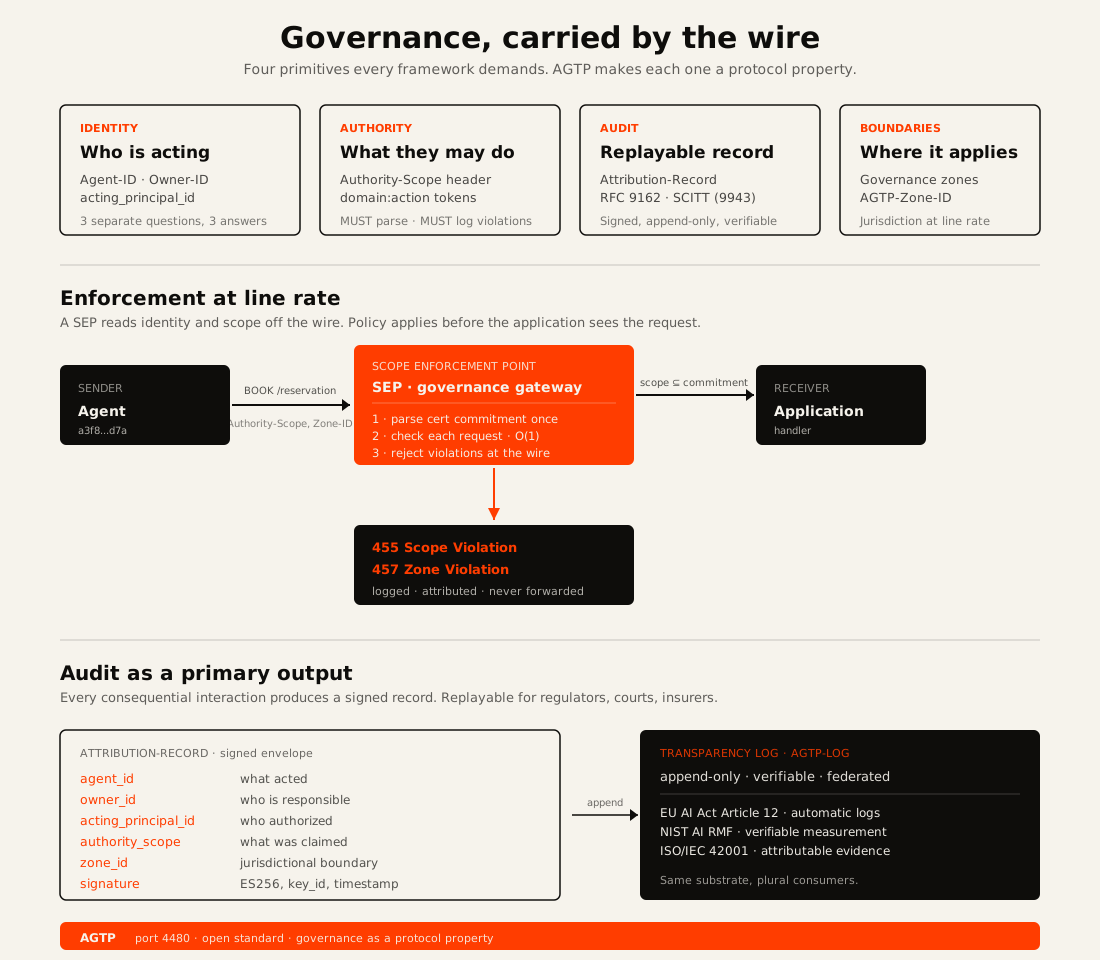
Identity as a governance primitive
Every non-anonymous AGTP request carries Agent-ID, the canonical 256-bit identifier derived from the agent’s signed Agent Genesis. The Agent-ID is stable across hosts, sessions, and credentials. It survives domain changes. It survives operator changes. It identifies the agent itself, the way a vehicle identification number identifies a car, independent of who is driving or where it is parked.
Alongside it, Owner-ID identifies the principal accountable for the agent. A registered organization, a legal entity, or a human who must answer when something goes wrong. The Owner-ID provides the policy with an accountability terminus. Without one, regulators have an actor with no one to call.
When OAuth composes on top, a third identifier rides in the application layer: the acting principal whose authority the agent is currently exercising. Three identifiers, three different questions, three different policy hooks: what acted (Agent-ID), who is responsible (Owner-ID), who authorized (acting principal).
Most agent governance frameworks today fuse these three into a single identifier or skip one entirely. The result is a policy that cannot answer a regulator’s basic questions without forensic reconstruction. AGTP carries the answers natively on every request.
Authority as a wire-level constraint
The Authority-Scope header is where governance becomes enforceable. Every AGTP request declares what the agent is asking to do, in domain:action form drawn from a reserved registry of governance-relevant domains: calendar, documents, knowledge, booking, payments, agents (delegation), escalation, discovery, budget, telemetry, zone, suspend.
Compliant AGTP servers MUST parse Authority-Scope on every request, return 455 Scope Violation for any method that exceeds the declared scope, and log all scope violations. The MUST is what makes this infrastructure stand out from conventional infrastructure. A server that ignores Authority-Scope is non-compliant in the same way an HTTP server that ignores the Host header is non-compliant. The behavior is required, with the force of a normative protocol rule rather than a style guideline.
A scope violation is treated as a governance signal rather than a protocol error. The status code says “this agent attempted something outside its authority.” It gets logged. It feeds anomaly detection. It triggers the escalation policy if the deployment configures one. This is the part most application-layer governance frameworks fail to provide: a structured, standardized signal that policy enforcement happened, distinguishable from ordinary error traffic.
The threat model is named explicitly. Authority laundering is when an agent claims a broader scope than it was granted: the server enforces, logs, and refuses. Delegation chain poisoning is when a malicious agent inserts itself into a DELEGATE sequence: each hop’s scope must be a strict subset of the delegating agent’s scope, and chain breaks return 551 Authority Chain Broken. Agent spoofing occurs when a malicious actor forges identity headers. Cryptographic verification against the signed Agent Identity Document closes the gap.
Each of these is a known governance failure mode in the wild today. AGTP names them and supplies the protocol primitive that closes them.
Enforcement at line rate
There is a question every governance team eventually asks. If enforcement is a property of the protocol, how expensive is it at scale?
The honest answer for most application-layer governance is “expensive enough to skip on hot paths.” Every request that needs to be checked must go through a policy engine, which introduces latency, complexity, and pressure to bypass enforcement for performance-critical traffic. This is how governance erodes.
AGTP-CERT defines a Scope Enforcement Point: an AGTP-aware load balancer, gateway, or proxy that enforces Authority-Scope at O(1) cost per request. At session establishment, the SEP parses the authority-scope-commitment extension from the agent’s certificate once. On every subsequent request, the SEP checks whether the request’s Authority-Scope tokens are a subset of the parsed commitment. If they are, the request proceeds. Otherwise, the SEP returns 455 Scope Violation without forwarding the request to the application.
The same mechanism handles governance zones. A governance-zone extension on the certificate names the zone the agent is registered in. SEPs can enforce that the request’s AGTP-Zone-ID header matches that zone, returning 457 Zone Violation for cross-zone traffic that policy forbids. This is the primitive that makes jurisdictional separation a property of the infrastructure rather than an application concern.
Enforcement at line rate means governance can be applied to every request, including the requests the application would otherwise have forgotten to check. The economy changes. Policy stops being a sampling problem and becomes a uniform property of the network.
Audit as a primary output
Every consequential AGTP interaction can produce an Attribution-Record, a signed envelope binding the responding agent’s identity, the request hash, the response status, and the acting principal claim into a single artifact. Attribution-Records are designed for append-only transparency logs aligned with RFC 9162 (Certificate Transparency 2.0) and RFC 9943 (SCITT).
Three properties matter here. The records are signed, so they cannot be repudiated. They are written to append-only logs, so they cannot be altered. They are structured the same way across every AGTP implementation, so they can be replayed by tools that no AGTP vendor wrote.
This is the property that compliance frameworks have been demanding from agent systems and that agent systems have been failing to deliver. The EU AI Act’s Article 12 requires automatic logging of high-risk AI system operations. The NIST AI RMF’s “Measure” function requires verifiable measurement of system behavior. Both demands collapse to a question of whether the logs are trustworthy. Attribution-Records make them trustworthy by design.
A regulator asking “what did this agent do in Q3” gets a tractable query: replay the Attribution-Records for the Owner-ID over the time window, verify the signatures, and reconstruct the sequence. A counterparty in a dispute over a transaction gets the same artifact. An incident responder triaging a compromise gets the same artifact. The substrate is shared, so the consumers can be plural.
Governance zones and the jurisdiction problem
The hardest part of AI governance is that policy is never global. Different jurisdictions have different rules. Different organizations have different risk postures. Different operations require different controls. A policy that fails to encode boundaries is a policy that fails when it comes into contact with the actual deployment surface.
AGTP defines governance zones as a first-class concept. A zone is a named policy boundary: zone:eu-gdpr, zone:us-healthcare, zone:retail-verified, zone:research-only. Agents are registered in zones at activation. Requests carry an AGTP-Zone-ID header. SEPs enforce zone boundaries at line rate. Cross-zone traffic that policy permits passes through; cross-zone traffic that policy forbids returns 457 Zone Violation.
This sounds technical, and at the wire it is. The policy implication is large. An agent registered in a GDPR-bound zone cannot reach a non-GDPR data resource through an enforcing SEP. An agent registered in a healthcare zone cannot interact with non-healthcare services without an explicit cross-zone authorization. The boundaries that policy has historically drawn on paper become boundaries that the infrastructure enforces on every packet.
The zone primitive enables multinational, multi-regulatory deployments to operate without writing custom enforcement code for every regional combination. The protocol carries the boundaries. The infrastructure honors them.
The shape this gives governance
Step back and look at what becomes possible when these primitives are stable across implementations.
Cross-organization auditability becomes routine. Two agents from two different companies operating under two different governance regimes can interact with full attribution carried natively in the protocol. The receiving company’s audit trail is compatible with the sending company’s audit trail because both are AGTP Attribution-Records. Compliance reconciliation stops being a custom integration.
Regulatory verification becomes self-service. A regulator with read access to the transparency logs and the registry can verify policy adherence without depending on each operator to produce custom reports. The data is structured, signed, and replayable. The regulator builds tools once and uses them everywhere.
Policy evolution becomes tractable. When the rules change (and they will), the existing logs remain interpretable because the schema is stable. Governance frameworks that embed enforcement in application code have a harder time adapting, because each framework’s interpretation of the old rules has to be migrated to the new rules separately.
Insurance, contracts, and dispute resolution become serviceable. A counterparty selling agent-mediated services to another counterparty can produce verifiable evidence of policy adherence at the moment of every transaction. Insurers can underwrite agent operations based on observable, signed behavior rather than on attestation. Contracts can specify governance properties that the protocol actually carries, rather than properties that depend on each party’s framework happening to capture them.
These are infrastructure consequences. They are what governance gets when its primitives become protocol primitives.
The choice
Most of the AI governance work being done right now is good, but it’s built on a foundation that cannot carry it. The frameworks are clear. The policies are sound. The audits are diligent. And underneath all of it, the agents are communicating over a transport that has no idea any of those things exist.
The substrate has to know. That is the lesson SMTP taught email. It is the lesson TLS taught web security. It is the lesson Certificate Transparency taught trust. The policies above can only be as good as the wire below.
AGTP is the wire that agent governance has been waiting for. Identity, authority, audit, and boundaries are carried as protocol properties. Enforcement at line rate. Compliance as a first-class output. Cross-organization interoperability should be a default rather than a bilateral negotiation.
Governance becomes infrastructure when the protocol carries it. The protocol exists. The work now is recognizing that the right place to enforce policy is the same place the policy is communicated, and building from there.
If you find this content valuable, please share it with your network.
Follow me for daily insights.
Book me to speak at your next event.
Start managing your agents for free.
Chris Hood is an AI strategist and author of the #1 Amazon Best Seller Infailible and Customer Transformation, and has been recognized as one of the Top 30 Global Gurus for Customer Experience. His latest book, Unmapping Customer Journeys, is available now!