Multi-Model Governance without Multi-Perspective Evaluation
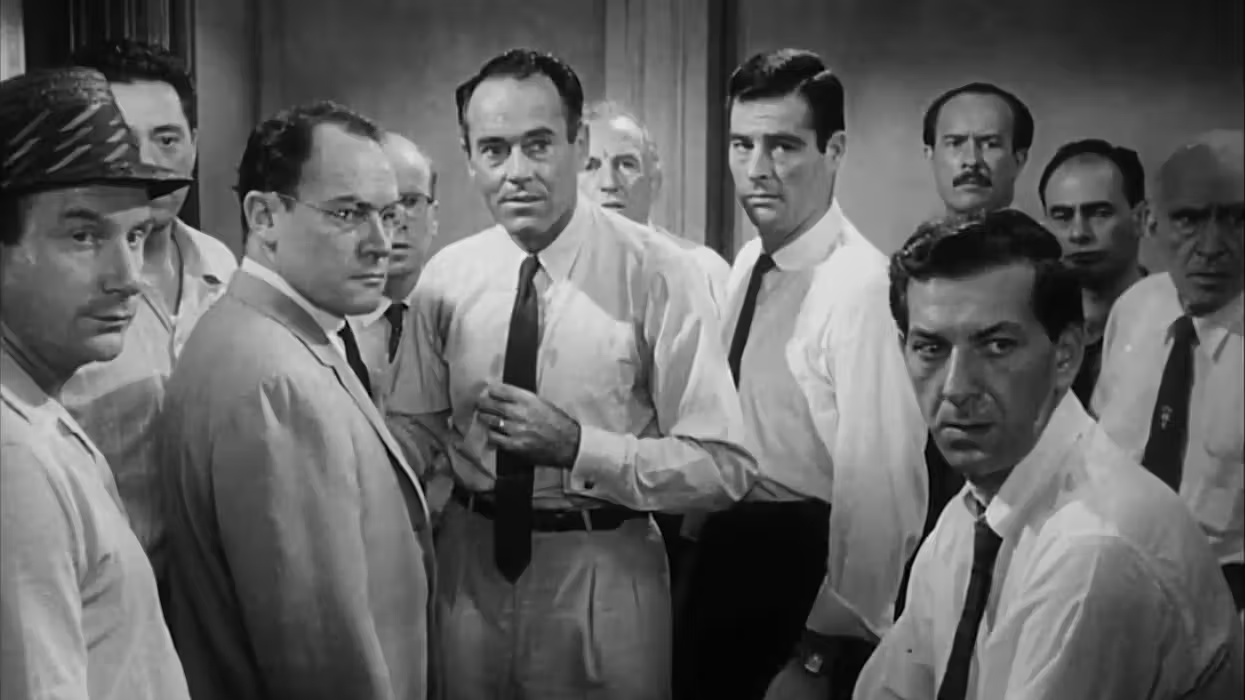
New York City. Summer, 1957. Twelve men in a jury deliberation room. The air conditioner is broken. The foreman calls for an initial vote on a first-degree murder charge. Eleven hands go up for guilty. One juror, wearing a white suit, keeps his hand down.
He has yet to present any argument that the defendant is innocent. He just wants the jury to talk about it.
What follows is ninety minutes of argument in which the eleven-to-one vote slowly inverts. The jurors who flip do so because of things other jurors had no way to know. One grew up in a tenement and recognized how a switchblade is actually held. One wore glasses and noticed the star witness carried pressure marks on her nose, marks someone only develops from reading glasses, she claimed never to wear. Another had painted houses for decades and knew the freight train outside the courtroom window would have drowned out the words the witness swore she heard.
The initial consensus was that 11 people would vote the same way. It looked like an agreement. The room was hot, they wanted to get home, the defendant came from the wrong neighborhood, and the prosecution had presented a tidy story. Their agreement meant almost nothing. What produced the verdict was a different grounding: different lived experience, different domain knowledge, different attention to details that the shared prior had overlooked.
Sidney Lumet’s 12 Angry Men is considered to be one of the top legal films of all time. He made a film about jury deliberation with 12 characters in one room. He also made a film about multi-perspective validation, and 69 years later, it remains the clearest argument for why most AI governance setups fall short of what people believe they’re getting.
The eleven-to-one problem
Every few weeks, I see a new AI governance architecture built on the assumption that running a prompt through three or four models produces independent validation. They treat the agreement between those models as confirmation.
The models being compared usually share more DNA than procurement teams realize. Many commercial AI platforms are wrappers on a small set of base models, run fine-tuned derivatives of open weights that competitors also use, or consume the same foundation model through different API endpoints. Two platforms with different names can execute inference against models pretrained on overlapping corpora, aligned through RLHF pipelines with overlapping annotator pools, and evaluated against the same public benchmarks.
When those systems agree, they might be confirming each other. They might also be eleven jurors voting the same way because they read the same newspaper before entering the courthouse. Platform count and architectural independence are different things, and the industry has been consolidating in ways that make real independence scarcer every quarter. Two GPT-family platforms and one Claude-based platform add up to closer to 1.5 opinions than 3.
Shared foundations import shared blind spots. A failure mode latent in the base model travels into every derivative. A bias latent in the pretraining corpus is inherited by every model trained on it. A hallucination pattern produced by the base model under specific prompt structures appears in every product built on top of it. Downstream fine-tuning changes surface behavior while the underlying prior stays intact.
A Shared Perspective
Even when base models are genuinely distinct, training corpora overlap heavily. Common Crawl, Wikipedia, Reddit, GitHub, major news archives, and academic papers that appear in the usual scrapers. The effective corpus of the public internet is finite, and the curation choices of major lab data teams converge on substantially the same sources. Models trained on overlapping text converge on overlapping positions, especially on questions where the corpus itself has opinions.

Fabricated citations are the cleanest example. An academic claim that fails to appear in the cited paper but surfaces in summarization databases, AI-generated secondary sources, or lazy web writing gets repeated across training data. Five different models will confidently return that claim with the same attribution. The citation is fabricated. The convergence is real. More models reading the same erroneous source produce stronger false confidence, rather than stronger detection.
The same dynamic applies to stale statistics, industry folklore, popular misreadings of legal or scientific positions, and the opinions that internet writing repeats often enough to saturate the pretraining distribution. Calibration across models tends to correlate with exactly the examples where the corpus is wrong, because the wrongness is baked into the prior that the models share.
This is the structural limit of multi-model cross-validation: it catches divergent hallucinations and misses convergent ones. Convergent hallucinations are the ones that matter because they read as confirmed fact. The eleven-to-one vote at the start of the film looked like overwhelming evidence. It was actually an artifact of shared bias that none of the eleven jurors could see from inside their own heads.
Juror 8’s actual advantage
Real perspective diversity arises from something beyond different transformer weights. It emerges from a different grounding.
The jurors who changed the verdict drew on specific contextual knowledge that the other jurors lacked. One had lived in neighborhoods where switchblades were common. One had spent decades paying attention to the freight line outside the window. The system that produced a different answer was the system with a different relationship to the underlying reality.
In AI terms: a model deployed in a healthcare context with clinical guidelines, SNOMED ontology, and patient safety priorities behaves differently from the same model deployed in a marketing context with brand guidelines and engagement metrics. The system prompt, the retrieved context, the allowed tool surface, the value framing, and the constraints on output shape all produce different behavior. The divergence lives in the context layer rather than the weight layer.
Two differently-grounded systems running on the same base model will often produce more useful disagreement than two identical stacks running on nominally different models. The variance that matters is architectural and contextual. The variance you get from switching vendors is largely stylistic, and stylistic variance is cosmetic.
Building the jury room
Running 12 AI models in parallel for every decision is impractical and expensive. Running even three creates latency and cost problems that make ensemble validation unworkable at scale. And as the sections above establish, even modest ensembles carry correlation risk that the ensemble design was meant to eliminate.
The principle underneath 12 Angry Men survives the impracticality of literal jury panels for every agent decision. The principle is that a decision worth making at scale is worth testing against something other than itself. The validator needs different grounding, different evidence, different priors. Ideally, the validator needs entirely different mechanics.
Nomotic was built around that idea. The governance layer evaluates every agent’s decision and was designed from the beginning to behave differently from the agents it governs. Rather than asking another LLM to judge the first LLM’s output, the evaluation operates on rules, policy constraints, formal verification, and institutional context that the agent itself has no access to. An LLM judging another LLM is a pipe that can think, and anything that can think can be prompt-injected into agreement. A policy engine resists that attack because it was never vulnerable to it.
The multi-perspective validation of the final verdict rested on jurors whose relationship to the evidence was fundamentally different from the jurors who started with “guilty.” That is the design pattern. Different mechanics, different grounding, different kinds of evidence.
Hands and soul
Agentic systems are the action. They are the hands. They make calls, execute workflows, take positions, and produce outputs that affect the world. They are the jury doing the work of reaching a verdict.
Governance is the law. It is the soul. It is the framework within which action becomes legitimate rather than arbitrary. The rules of evidence, the standard of proof, and the instructions the judge reads before deliberation begin. Without that framework, the jury is 12 people in a hot room, voting on gut feelings.
Nomotic was always designed as a companion to agentic systems, occupying the layer that makes action answerable. Agents decide. Nomotic tests those decisions against standards that the agents themselves have no way to generate. One is the doing. The other is the why-this-is-allowed. The hands move. The soul decides whether the movement was right.
The architecture matters because action without soul becomes confidently wrong at scale. That is the failure mode most AI deployments are walking toward right now, with ensemble validation as the comfort blanket that hides the problem. Eleven hands raised in agreement meant nothing in Lumet’s jury room until Juror 8 asked the question the other eleven had skipped. AI governance needs the same structural question held against it, continuously, at runtime, against every action an agent takes.
The verdict that fails
The comfortable version of AI governance treats ensembles as rigor and vendor diversity as independence. The harder version asks what actually makes two perspectives independent, and accepts that the answer is rarely “use a different vendor.”
Five systems trained on overlapping data producing the same answer is correlation. Building governance on that correlation produces confident systems that fail the same way at the same time, which is the worst failure mode available because no one sees it coming until it has already propagated through every downstream decision.
Diversity of output requires diversity of input. Diversity of judgment requires diversity of grounding. Diversity of perspective requires diversity of the things that actually produce perspective, and the weights are the smallest component of that list.
The twelfth juror stayed in his seat because he refused to call a consensus a verdict. Every agentic system running in production deserves the same question: Is this convergence a signal, or is it eleven people voting the same way for the same reason?
If you find this content valuable, please share it with your network.
Follow me for daily insights.
Book me to speak at your next event.
Chris Hood is an AI strategist and author of the #1 Amazon Best Seller Infailible and Customer Transformation, and has been recognized as one of the Top 30 Global Gurus for Customer Experience. His latest book, Unmapping Customer Journeys, will be published in 2026.