
Artificial Intelligence has Unmapped Customer Journeys
I have been saying for years that traditional customer journey maps are lying to us.
The format is dishonest. A linear map with stages arranged left to right, arrows pointing forward, customers moving obediently from awareness to consideration to purchase to loyalty, encodes a fantasy of how humans actually behave. It describes the journey the organization wants customers to take, not the journey customers are actually on.
AI has not just complicated this problem; it has made it more complex. It has made the linear map actively harmful as a business tool. And the conversation I have been having about multidimensional customer experience for years finally has a book behind it.
Unmapping Customer Journeys, published by De Gruyter, is an invitation to stop trying to control the journey and start learning to travel with your customers.
What AI Did to the Funnel
The funnel was already a simplification. Awareness feeds consideration, which feeds intent, which feeds purchase. Old models described a rough probability gradient rather than human experience. Marketers used it because it was measurable and because it gave a false sense of control over something that was never fully controllable.
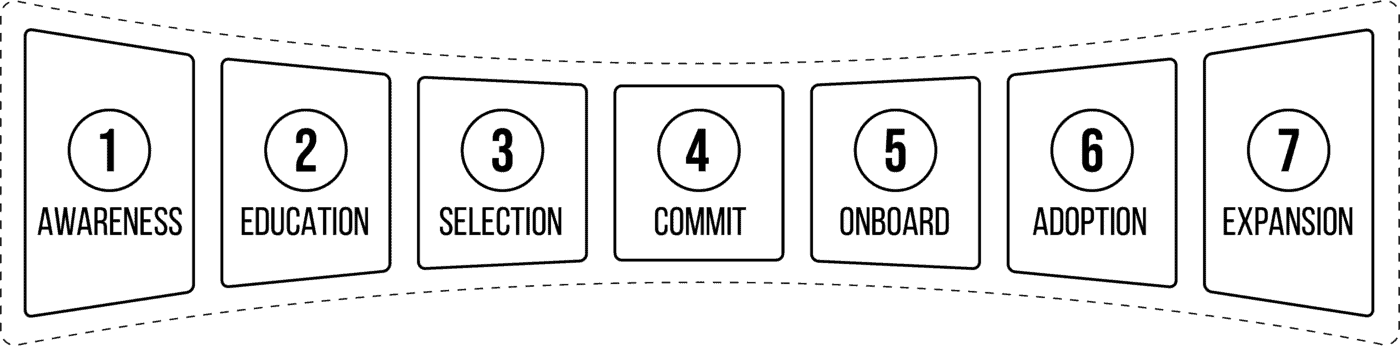
AI has collapsed the funnel from the inside.
Consider what happens when someone asks an AI assistant: ” What is the best project management tool for creative teams under fifty dollars per user?” In a single conversational turn, that person has performed awareness, education, comparison, and near-commitment simultaneously. They discovered what exists, evaluated their options, applied their constraints, and moved toward a decision, all in one exchange. The funnel stages that would have taken weeks in a traditional research process happened in seconds.

This is not a marginal acceleration. It is a structural collapse. The stages that businesses built their entire go-to-market architectures around are coexisting rather than sequencing. Onboarding and discovery are happening simultaneously. Education and adoption in parallel. Expansion begins at the moment of commitment. The pipeline is not moving faster. The pipeline is becoming a different shape entirely.
Cognitive Off-loading and the New Decision Architecture
The compression effect has a psychological mechanism behind it that the book explores in depth.
Cognitive psychologists call it cognitive off-loading. The process of using external tools to reduce mental effort. When AI handles the information-processing tasks that previously required extended human research, it frees up cognitive resources while simultaneously changing how decisions are structured and evaluated. The person is no longer gathering information over time and synthesizing it into a judgment. They are receiving a synthesized judgment from a system they have come to trust, and building on it.
This matters enormously for how businesses think about the customer relationship. The customer is no longer arriving at your website, your content, or your sales team in an exploratory state. They are arriving with a position already formed, often reinforced multiple times by AI interactions that they found more credible and more efficient than a branded content experience.
The book describes this process as mentormorphosis. The gradual transformation of AI from a neutral assistant into a mentor-like figure in a customer’s mental hierarchy of trust and authority. The challenge for businesses is not that AI is competing with them for the customer’s attention. It is that AI has become the trusted authority, and the commitment is reinforced through AI interactions far more deeply than a customer would get from reaching out to a brand directly.
The 4L Framework
The book introduces a new multidimensional journey mapping framework built around four dimensions of how customers actually move through experience.

Layers are the emotional and contextual depths beneath every interaction. What customer feeling is not visible in the behavioral data? What context, drawn from their life outside the brand relationship, is shaping how they interpret the experience?
Lanes are the parallel paths of influence operating simultaneously. A customer is never on just one path. They are consuming content, talking to peers, processing AI recommendations, and forming impressions through channels the organization has no visibility into. The lane model accounts for all of these rather than pretending the experience is a single-threaded conversation between customer and brand.
Loops are the cyclical validation behaviors that customers use to confirm decisions. Traditional maps treat commitment as a single moment. The reality is that customers loop back, revalidate, seek confirmation, and recalibrate throughout the relationship. Understanding where the loops occur and what triggers them is more valuable than knowing the conversion moment.
Liminals are the threshold moments of transformation. The points in a customer’s experience where something shifts, where their relationship with the category, the brand, or their own identity changes in a way that is irreversible. Traditional maps often miss these because they are invisible in behavioral data.
Together, these four dimensions produce a map that looks less like a flowchart and more like the actual topology of human experience.
From Stages to Milestones
The reorientation the book asks of CX leaders is specific.
Stop asking how long it takes a customer to move from stage one to stage two to stage three. Start asking at what point they reach a particular milestone, regardless of what path they took to get there.
This shift matters because the path is no longer yours to define. The customer arrived at awareness through an AI conversation you did not host. They completed their evaluation through a comparison process you did not participate in. They reached commitment through a sequence of interactions that your journey map did not anticipate.
What you can know is whether they reached the milestone. What you can design for is the experience of arriving at the milestone, from whatever direction they came. The milestone model is robust to the path variability that the linear model cannot survive.
Why This Book, Why Now
The timing of this book is deliberate. Not because multidimensional journey mapping is a new idea. Because AI has made the linear model untenable, organizations are seeking a replacement.
De Gruyter approached me last year to develop this framework as a book, and the timing aligned with what I have been watching in the market. CX leaders know their journey maps are inadequate. They can see customers arriving through paths the maps do not account for, making decisions at speeds the maps cannot represent, and trusting sources the maps do not include.
Unmapping Customer Journeys is the framework for what comes next. Choremotion, the rhythm of feelings and actions. Driftprints are the invisible behavioral imprints that reveal where customers are actually going. The neural drivers of choice and the AI compression effects on decision architecture. The organizational changes are required to move from controlling the journey to traveling alongside the customer.
If you find this content valuable, please share it with your network.
Follow me for daily insights.
Book me to speak at your next event.
Start managing your agents for free.
Chris Hood is an AI strategist and author of the #1 Amazon Best Seller Infailible and Customer Transformation, and has been recognized as one of the Top 30 Global Gurus for Customer Experience. His latest book, Unmapping Customer Journeys, is available now!