
The Narrow Waist Architecture of the Agent Transfer Protocol
The AI industry has been building an impressive vocabulary for agent communication. Model Context Protocol defines how agents invoke tools. Agent-to-Agent Protocol defines how agents delegate tasks. These specifications are effective at what they do. They describe what agents say, how they format requests, and how they hand work to each other.
Listen to commentary about the Agent Transfer Protocol
They all share the same foundational problem. They run over HTTP.
An AI agent executing an automated financial transaction uses the same infrastructure as a human clicking a link in a browser. To a load balancer, an agent task delegation is indistinguishable from a standard user POST request. The network is unaware that anything different is happening.
This is an architectural problem that compounds as agent traffic scales.
The Cost of Payload-Level Governance
Because the network cannot distinguish agent traffic from human traffic at the transport level, any system that wants to govern agents must inspect the application payload. To find out which agent is making a request, what authority it holds, and what resource budget applies to the action, current systems have to pause routing, parse the internal JSON, and make decisions from inside the message.
Parsing complex payloads at the network edge is computationally expensive. It degrades routing throughput. Worse, it places the security perimeter at the application layer, where prompt injection and schema manipulation attacks originate. The infrastructure component responsible for protecting the network is reading the very payload that attackers are trying to manipulate.
Embedding identity, security, and governance inside the application payload is a design failure. A network that has to read every message to know where to send it cannot scale with the volume of an agent ecosystem.
What AGTP Addresses
Agent Transfer Protocol (AGTP) addresses this by applying the same design principle that made the internet scale.
IP carries email, video, and financial transactions with equal indifference to their contents. It provides a universal delivery mechanism. IP routes packets without understanding their contents. The intelligence lives in the layers above. The transport layer stays minimal, universal, and fast.
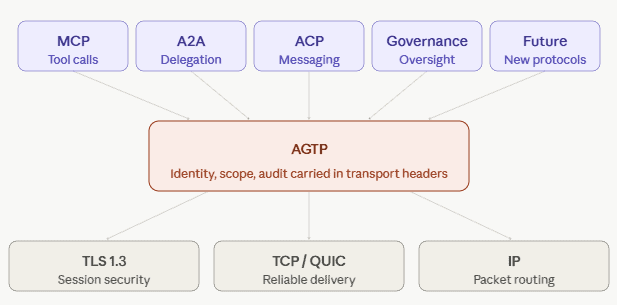
AGTP provides that same universal layer for agent traffic. Because it sits beneath the messaging layer, the AGTP substrate can carry any agent messaging protocol payload, MCP, A2A, or others, without needing to parse or understand the content inside. The agent’s identity, authority scope, and audit information move out of the application body and into the transport headers, where infrastructure can read them without opening the payload.
An MCP tool call travels inside the body of an AGTP query method. The exterior of the packet carries dedicated AGTP headers with the canonical agent ID and the exact authority scope required for the action. The infrastructure reads the envelope. The contents stay private.
The Precedence Rule
This structure enables the precedence rule that AGTP calls.
Gateways and firewalls rely strictly on the exterior AGTP headers for routing decisions. If an internal payload claims an identity different from the AGTP header, the transport header wins. The infrastructure obeys the envelope.
If the AGTP headers are absent or cryptographically invalid, the packet is dropped. A perfectly formatted interior payload carries no weight. Without a valid transport identity, the request fails immediately. Infrastructure components become structurally immune to payload-level deception because they have no need to examine the packet to determine who sent it.
This eliminates an entire class of attacks at the network edge rather than attempting to detect them at the application layer.
Cryptographic Identity at the Handshake
For high-stakes operations, AGTP requires cryptographic proof of identity before establishing a connection.
The AGTP-Cert extension integrates agent identity directly into the TLS 1.3 mutual authentication handshake. An agent certificate uses standard X.509v3 extensions to bind the canonical agent ID to the session. Critically, it includes an authority scope commitment and an Ed25519 signature that explicitly define the actions this agent is permitted to perform.
The component responsible for validating this certificate is called a Scope Enforcement Point. During session establishment, the SEP performs a single, computationally intensive Ed25519 signature verification. After that initial verification, subsequent requests are checked instantly against plaintext headers and the initial commitment. The heavy cryptographic work happens once. Every subsequent check is constant-time.
This is the O-complexity property that enables scalable enforcement. In a network processing millions of agent requests, variable latency can form a bottleneck that cascades into system-wide degradation. Constant-time enforcement means governance decisions happen at the speed of hardware packet switching, regardless of traffic volume. Strict enforcement and scale coexist without compromise. Both hold simultaneously.
The Audit Trail Problem
Traditional application-layer logging has a structural weakness that AGTP-Log addresses directly.
In conventional architectures, the audited party writes the audit trail. A compromised agent can alter its own logs to conceal its actions. The integrity of the audit record depends on the integrity of the audited actor, which is precisely the situation where integrity cannot be assumed.
AGTP-Log shifts the signing authority. Log statements are signed exclusively with the governance platform’s key, not the agent’s. The agent holds zero write access to the log. Every identity event and lifecycle transition is recorded in a sequential block, cryptographically chained to the previous block. No entry can be altered without breaking the chain.
External monitors continuously verify the log using consistency proofs. The governance platform itself cannot present a split view or alter past records without the manipulation being detectable by cryptographic means.
Auditing transforms from a policy-driven aspiration into a structural guarantee. The agent cannot write its own history. The record is maintained by the infrastructure that governs it, and it is signed with a key the agent cannot access.
Dynamic Discovery with Behavioral Trust
With identity, scope, and audit trails secured at the transport layer, agents still face a practical question: how do they find the right peer to delegate a task to, without hardcoded static endpoints that require manual maintenance?
AGTP’s Agent Name Service handles this through the native DISCOVER method. Agents query a governed registry based on required capabilities and trust requirements. The registry returns ranked candidates.
The ranking combines two independent signals. Trust tier is a static cryptographic classification: Tier 1 agents are cryptographically verified at registration via DNS challenges or inclusion in a transparency log. Tier 2 agents carry only organizational assertion without cryptographic proof. The behavioral trust score is the dynamic component: a continuous value from 0.0 to 1.0 reflecting operational history, successful delegations, and scope violations over time.
The ANS server acts as a Scope Enforcement Point for discovery itself. It filters results based on the querying agent’s authority, blocking results for peers the querying agent is not authorized to interact with. The discovery process is governed alongside the interactions that follow from it.
What This Changes
Moving identity, scope, and audit authority out of the application payload and into the transport layer shifts where governance lives.
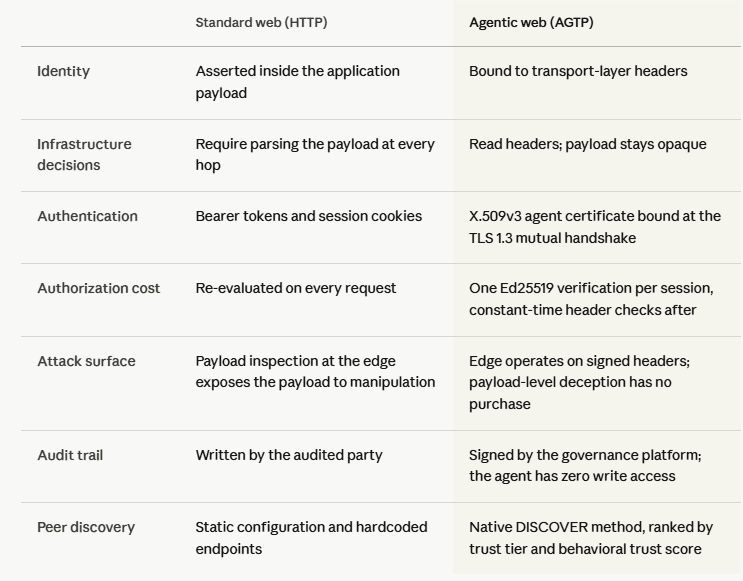
Current approaches push governance into the application. Infrastructure has to parse payloads to make decisions. Governance is expensive, slow, and vulnerable to the same attacks it is trying to prevent.
AGTP pushes governance into the network. Infrastructure reads headers. Decisions happen at constant time. The payload stays opaque. Prompt injection and payload-level deception lose their attack surface at the perimeter, because the perimeter operates on headers alone.
Regulators and compliance teams gain access to cryptographically signed, append-only audit trails that establish who took what action under whose authority, without accessing the content of the agent’s conversation. Privacy and accountability coexist because they operate at different layers.
Agent orchestration scales dynamically because discovery is ranked by behavioral evidence rather than maintained by static configuration. New agents enter the ecosystem with a cryptographic identity established at registration and behavioral trust earned through operation.
The internet scaled because IP provided a universal, minimal transport layer and allowed application intelligence to develop above it without being constrained by the transport’s understanding of that intelligence. AGTP applies the same principle to the agent ecosystem.
The infrastructure governs how agents act without needing to understand what they are doing.
If you find this content valuable, please share it with your network.
Follow me for daily insights.
Book me to speak at your next event.
Start managing your agents for free.
Chris Hood is an AI strategist and author of the #1 Amazon Best Seller Infailible and Customer Transformation, and has been recognized as one of the Top 30 Global Gurus for Customer Experience. His latest book, Unmapping Customer Journeys, is available now!