The 8 Types of AI that Matter to Business Leaders
A Practical Taxonomy for Leaders
The AI conversation is exhausting. Vendors claim artificial general intelligence is imminent and every product is ‘revolutionary.’ Business leaders are left wondering which capabilities exist, which problems they solve, and how the pieces fit together.
This guide cuts through the noise. It presents eight distinct categories of AI, each with technical foundations, strengths, and applications. Some have decades of refinement behind them. Others are emerging rapidly. All of them deserve a clearer understanding than the marketing hype provides.
More importantly, this taxonomy highlights a key gap: the difference between capability and governance. Seven categories focus on what AI can do; Nomotic AI addresses what it should do. Both matter. Ignoring either creates risk.
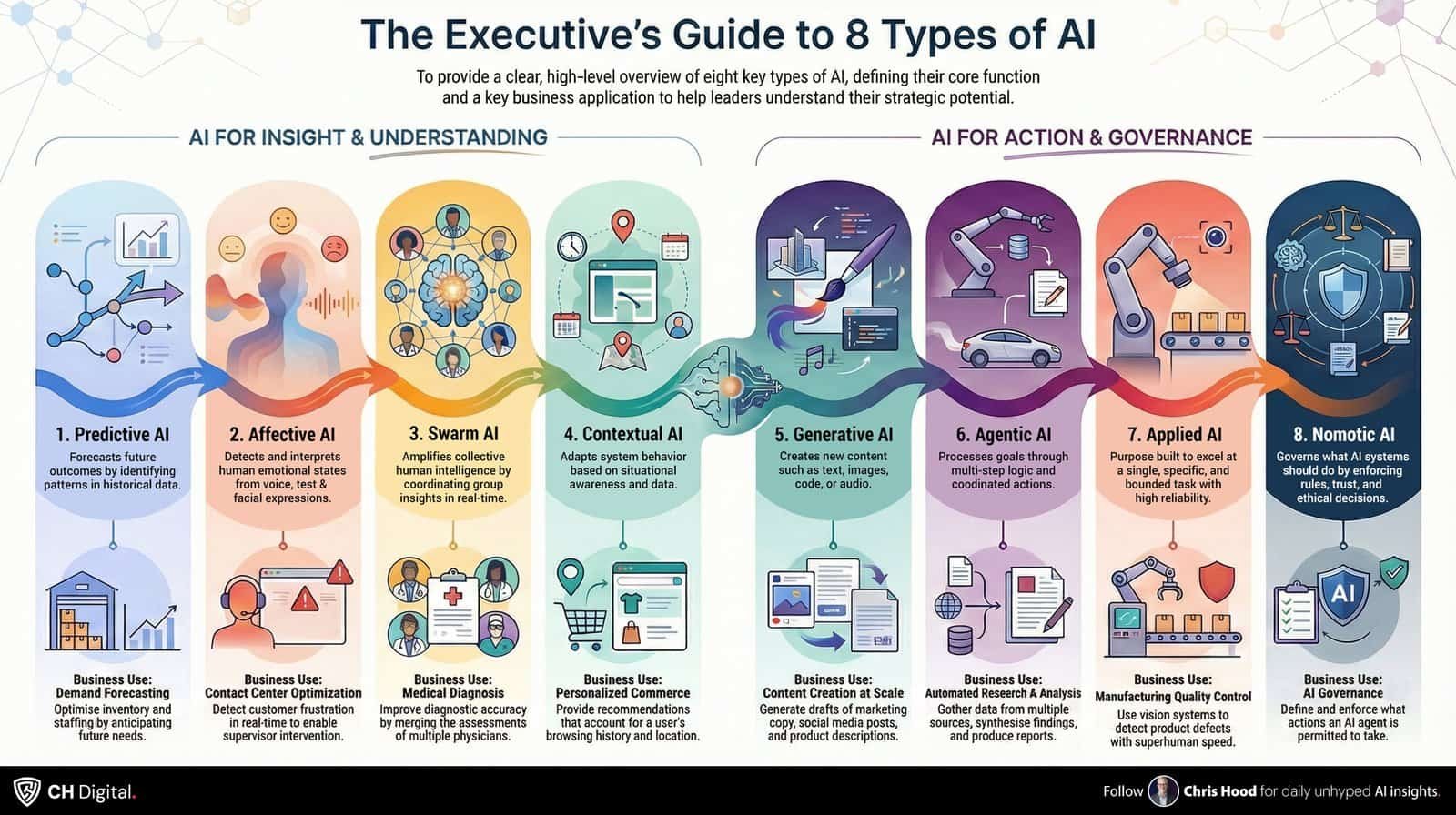
1. Predictive AI
What It Is
Predictive AI uses statistical models and machine learning to forecast future outcomes based on historical data. It identifies patterns, calculates probabilities, and tells you what’s likely to happen next.
This is narrow AI built for specific prediction tasks rather than general reasoning. It’s among the most mature categories, with decades of algorithm refinement.
The Technical Foundation
Predictive AI includes regression, decision trees, random forests, boosting, and neural networks trained on past data. All extract patterns from history to forecast probabilities.
Business Applications
- Customer churn prediction identifies which customers are likely to leave before they do, enabling proactive retention efforts.
- Demand forecasting optimizes inventory, staffing, and resource allocation based on anticipated needs.
- Fraud detection flags anomalous transactions in real time by comparing them against established behavioral patterns.
- Predictive maintenance anticipates equipment failures before they occur, reducing downtime and repair costs.
- Credit risk assessment evaluates loan default probability with greater accuracy than traditional scoring.
2. Affective AI
What It Is
Affective AI, also called emotion AI or affective computing, detects, interprets, and responds to human emotional states. It reads the signals we constantly emit, such as facial expressions, vocal tone, word choice, and physiological responses, and translates them into actionable emotional data.
This is still narrow AI, but it draws on computer vision, natural language processing, speech analysis, and sometimes biometrics. The aim is artificial emotional intelligence for specific contexts, not general intelligence.
The Technical Foundation
Affective AI systems analyze multiple signals, such as facial expressions, voice, and text, to detect emotions. Advanced versions combine these inputs for better accuracy.
Business Applications
- Contact center optimization detects customer frustration in real-time, enabling supervisors to intervene before situations escalate.
- User experience research moves beyond what customers say they feel to what they actually feel during product interactions.
- Mental health support powers applications that recognize patterns of emotional distress and provide appropriate resources.
- Adaptive learning platforms adjust the delivery of educational content based on learner engagement and confusion signals.
- Automotive safety monitors driver alertness and emotional state to prevent accidents.
3. Swarm AI
What It Is
Swarm AI amplifies collective human intelligence rather than replacing it. Inspired by how bird flocks, fish schools, and bee colonies make decisions, swarm AI creates systems in which groups of people think together in real time, their individual insights combined and refined through algorithms that surface emergent collective wisdom.
This represents a fundamentally different AI philosophy. Instead of training models on historical data to approximate human judgment, swarm AI keeps humans in the loop as active participants. The AI orchestrates and optimizes their collaboration; it doesn’t simulate or substitute for it.
The Technical Foundation
Swarm AI links users to share perspectives. Algorithms combine their inputs in real time, using swarm intelligence and game theory to guide group choices.
Business Applications
- Forecasting and prediction through swarm-based methods have outperformed individual experts and traditional polls in domains from sports to finance to geopolitics.
- Medical diagnosis using groups of physicians with swarm AI has demonstrated diagnostic accuracy improvements of 20-30% over individual assessments.
- Strategic planning captures nuanced organizational knowledge distributed across teams to inform major decisions.
- Market research moves beyond survey responses to dynamic collective insights that reveal preference intensities and trade-offs.
- Risk assessment aggregates expert judgment on complex, uncertain scenarios where no single model captures all relevant factors.
4. Contextual AI
What It Is
Contextual AI adapts its behavior based on situational awareness, understanding not just what a user asks, but when they’re asking, where they are, what they’ve done before, what they’re likely trying to accomplish, and what constraints apply to their specific situation.
Still narrow AI, but with ‘peripheral vision.’ Contextual AI retains and uses relevant background knowledge to provide responses tailored to the situation, not just isolated requests.
The Technical Foundation
Contextual AI merges time, location, behavior, role, and environment data. It uses these inputs, along with machine learning, to tailor responses to the situation.
Business Applications
- Personalized commerce delivers recommendations that account for browsing context, purchase history, current location, and even weather conditions affecting buying intent.
- Adaptive customer service provides support interactions informed by the customer’s full history, current sentiment, and likely intent before they explain their issue.
- Smart workspace tools surface relevant information based on current projects, meeting schedules, and collaboration patterns.
- Healthcare delivery provides clinical decision support that incorporates patient history, current medications, demographic factors, and care-setting constraints.
- Financial services provide advice and product recommendations calibrated to life stage, financial goals, risk tolerance, and market conditions.
5. Applied AI
What It Is
Applied AI describes artificial intelligence built for specific, bounded problems, systems designed to excel at particular tasks rather than demonstrate general capabilities. It’s AI as a precision instrument, not a Swiss Army knife.
This is definitionally narrow AI, and deliberately so. Applied AI embraces constraints. It trades breadth for depth, versatility for reliability, impressive demos for consistent production performance.
The Technical Foundation
Applied AI implementations vary enormously because they’re shaped by the problems they address. A visual quality inspection system uses convolutional neural networks optimized for defect detection. A legal document analyzer uses natural language processing tuned to identify contract clauses. A logistics optimizer uses reinforcement learning configured for routing efficiency. The unifying principle is purpose-built architecture: every design decision serves the specific application.
Business Applications
- Manufacturing quality control employs vision systems that detect defects with superhuman consistency and speed.
- Document processing enables the extraction and classification of information from invoices, contracts, claims, and correspondence.
- Supply chain optimization handles route planning, inventory allocation, and demand matching across complex distribution networks.
- Drug discovery accelerates pharmaceutical research timelines through molecular analysis and candidate identification.
- Agricultural optimization supports crop monitoring, yield prediction, and resource allocation for precision farming.
6. Generative AI
What It Is
Generative AI creates new text, images, audio, video, code, and more by learning patterns from vast training datasets and producing novel outputs that didn’t exist before. Unlike AI systems that classify, predict, or optimize, generative AI synthesizes.
Generative AI, while still narrow, excels at creation tasks. It generates new outputs by learning structure, style, and meaning, rather than just retrieving content.
The Technical Foundation
Generative AI is built on large language models (LLMs), diffusion models, generative adversarial networks (GANs), and transformer architectures trained on massive datasets. These systems learn statistical relationships between elements and use those relationships to generate coherent new sequences. Training requires enormous computational resources, but inference (generation) can run on increasingly accessible hardware.
Business Applications
- Content creation at scale generates marketing copy, product descriptions, social media posts, and documentation drafts that human teams refine and approve.
- Code generation and assistance accelerate software development by translating natural-language requirements into functional code and by explaining existing codebases.
- Design and creative prototyping produce visual concepts, UI mockups, and creative variations that compress ideation cycles from days to minutes.
- Knowledge synthesis summarizes lengthy documents, extracts insights from research, and translates complex information into accessible formats.
- Personalized communication drafts tailored customer correspondence, proposals, and responses calibrated to recipient context and relationship history.
7. Agentic AI
What It Is
Agentic AI describes systems capable of pursuing goals through multi-step reasoning, planning, and action execution with minimal human intervention between steps. These systems don’t just respond to prompts; they decompose objectives into tasks, select appropriate tools, execute sequences, evaluate results, and iterate toward completion.
This extends narrow AI into more sophisticated territory. Agentic systems combine perception, reasoning, planning, and action in ways that approximate goal-directed behavior. The “agency” lies in the system’s capacity to make intermediate decisions, recover from errors, and navigate toward outcomes without requiring human guidance at each step.
The Technical Foundation
Agentic AI integrates large language models with tool use, memory systems, and orchestration frameworks. The architecture typically includes a reasoning core that interprets goals and plans approaches, tool integrations that enable actions like web searches, code execution, or API calls, memory mechanisms that maintain context across steps, and evaluation loops that assess progress and adjust strategies. Frameworks like React, AutoGPT, and various agent-orchestration platforms provide the scaffolding.
Business Applications
- Research and analysis employ agents that gather information from multiple sources, synthesize findings, and produce structured reports without step-by-step human direction.
- Customer service resolution handles complex, multi-system inquiries by accessing relevant databases, executing transactions, and following resolution workflows end-to-end.
- Software development workflows complete coding tasks that span multiple files, run tests, debug failures, and iterate until acceptance criteria are met.
- Data pipeline operations monitor, troubleshoot, and optimize data flows by diagnosing issues and implementing fixes across connected systems.
- Procurement and vendor management execute sourcing tasks, including supplier research, comparative analysis, and initial outreach, in line with defined requirements.
8. Nomotic AI
What It Is
Nomotic AI governs what AI systems should do rather than what they can do. Derived from the Greek nomos (law, rule, governance), Nomotic AI provides the accountability layer that defines authorization boundaries, verifies trust, and evaluates whether actions are appropriate, not just executable.
This represents a fundamentally different orientation. While other AI categories focus on capability (what can be done) or application (what problems to solve), Nomotic AI focuses on governance (what should be permitted). It moves beyond rigid rule-based systems to contextual, adaptive enforcement that operates at runtime, before, during, and after AI actions occur.
The Technical Foundation
Nomotic AI integrates policy engines, trust verification mechanisms, and ethical evaluation frameworks into AI architectures. Core components include adaptive authorization systems that adjust permissions based on context and evidence, runtime evaluation that assesses actions against governance criteria in real time, audit mechanisms that maintain accountability traces to human responsibility, and transparency layers that make governance decisions explainable. The architecture is designed to be built in, not bolted on.
Business Applications
- Agentic AI governance defines and enforces what actions AI agents can take, under what conditions, and with what oversight requirements.
- Dynamic authorization adjusts AI system permissions based on verified trust levels, operational context, and risk assessments rather than static role-based rules.
- Ethical evaluation frameworks ensure AI actions meet justifiability standards, equitable and appropriate, not merely technically possible.
- Compliance automation translates regulatory requirements into enforceable runtime constraints that adapt as regulations and contexts evolve.
- Accountability architecture maintains clear traces from AI actions to human responsibility, enabling meaningful oversight of increasingly capable systems.
The Critical Relationship: Capability and Governance
Seven of these AI categories answer variations of the same question: What can AI do? They represent different capabilities, different technical approaches, and different applications. Predictive AI forecasts. Generative AI creates. Agentic AI acts. Each adds tools to the organizational toolkit.
Nomotic AI asks a different question: What should AI do?
This distinction matters more as AI systems become more capable. An agentic AI that can execute multi-step tasks without human intervention needs governance that operates at the same pace, evaluating, authorizing, and constraining actions in real time. A generative AI producing customer communications at scale needs guardrails that ensure outputs meet ethical and brand standards before they reach audiences.
The relationship between Agentic AI and Nomotic AI deserves particular attention. Agentic AI provides the capability layer: systems that perceive, reason, plan, and act. Nomotic AI provides the accountability layer: governance that ensures those actions are authorized, appropriate, and traceable to human responsibility.
Every agentic system benefits from a nomotic layer. Actions need governance to mitigate risks. Governance alone is ineffective without action. Both layers are structurally necessary for robust AI systems.
Moving Forward
Understanding these eight categories provides a foundation for a clearer AI strategy. It enables more precise conversations about what you’re actually implementing, what problems you’re solving, and what governance you need.
The taxonomy also reveals potential gaps in your organization. Many companies have invested heavily in predictive and applied AI. Fewer have mature approaches to affective or contextual AI. Most are experimenting with generative and agentic AI. Almost none have systematic approaches to nomotic AI, the governance layer that becomes essential as the other capabilities mature.
The question isn’t which type of AI to adopt. It’s about combining them appropriately for your context, with governance that aligns with your capability investments.
AI that can do more requires governance that does more. That’s not a constraint on innovation. It’s what makes sustainable innovation possible.
If you find this content valuable, please share it with your network.
Follow me for daily insights.
Schedule a free call to start your AI Transformation.
Book me to speak at your next event.
Chris Hood is an AI strategist and author of the #1 Amazon Best Seller Infailible and Customer Transformation, and has been recognized as one of the Top 40 Global Gurus for Customer Experience. His latest book, Unmapping Customer Journeys, will be published in 2026.