
Help Chris Hood rank among the world’s top CX leaders—vote now.

Nomotic AI.

The Governance Counterpart to Agentic AI.

AI governance in boxes

In the era of agentic AI, capability has outpaced governance. This paper introduces Nomotic AI as the necessary “law” to agentic AI’s “action”: a human-constructed governance layer ensuring accountability, verifiable trust, and ethical justification.

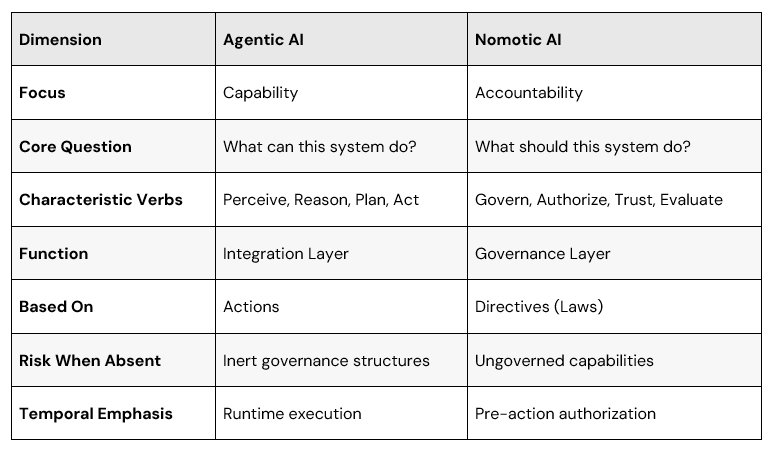
Agentic AI is about actions. What systems can do.

Nomotic AI is about laws. What systems should do.

Every AI agent needs both. 

Share your email and get the full paper (PDF). 

Nomotic AI Definition.

no·mot·ic | nō-ˈmä-tik

From Greek nomos (νόμος): law, rule, governance.

Nomotic AI refers to intelligent governance systems that define what AI should do, governing behavior through adaptive authorization, verified trust, and ethical evaluation, moving beyond rigid rules to contextual enforcement.

Where agentic AI asks: What can this system do?
Nomotic AI asks: What should this system do, and under what laws?

The Governance Gap.

The AI industry has spent years building agentic systems. AI that perceives, reasons, plans, and acts. AI that selects tools, connects to external services, and executes multi-step workflows.

But action without law is chaos.

Most organizations treat AI governance as a compliance layer, added after deployment to satisfy legal requirements or auditors. This approach guarantees tension. It positions governance as friction rather than foundation. It ensures responsible behavior is an exception to be enforced rather than a default to be expected.

Effective governance is not a checklist. It is an architectural decision.
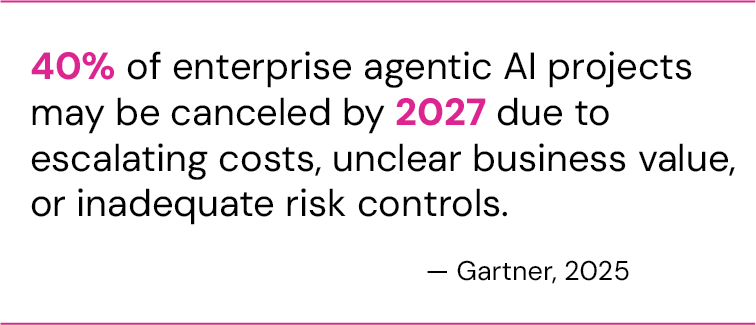
Gartner 2025 - 40% agentic AI projects may be canceled

When governance is designed into AI systems from the start, outcomes change. Clear boundaries reduce ambiguity. Defined authority eliminates confusion about decision ownership. Explicit constraints mean edge cases are anticipated rather than discovered in production. Organizations can explain not only what their AI systems did, but why those actions were appropriate and who authorized them.

The real risk is not AI capability. It is the gap between what systems can do and what they should do.

When an agent takes an action, who authorized it? When a workflow fails, who is accountable? When an outcome causes harm, can you explain why the system did what it did?

These questions cannot be answered retroactively. They must be answered by design.

Today, most organizations cannot answer them at all. Governance is scattered across prompts, configuration files, and tribal knowledge. Authority boundaries exist in someone’s head but not in documentation. Trust is assumed rather than verified. Ethical considerations surface only after something goes wrong.

The result is predictable. Industry forecasts suggest over 40% of enterprise agentic AI projects may be canceled by 2027 due to escalating costs, unclear business value, or inadequate risk controls. Security vulnerabilities. Unexpected behaviors. Regulatory exposure. Teams scrambling to add controls that should have been there from the beginning.

When governance feels heavy, it usually means the system was designed without it.

Nomotic AI changes this. It makes governance architectural, designed in from the start. It defines the laws under which agents operate before they act, not after they fail.

This is what AI governance should look like.
The Nomotic AI Framework.

Nomotic AI provides structure across four pillars:

Pillar 1: Govern

Pillar 2: Authorize

Pillar 3: Trust

Pillar 4: Evaluate

Establish the rules and boundaries.

Grant permission to operate.

Verify integrity and reliability.

Measure impact and ethical alignment.

Who makes the rules? How are they maintained? How do they evolve?

What is permitted? Under what conditions? With what limits?

What can you rely on? How is that reliance earned and verified?

Is this action appropriate? Fair? Explainable?

The foundation for policies, compliance, oversight, and controls.

The boundary for permissions, delegation, access, and accountability.

The basis for transparency, consistency, resilience, and risk management.

Four questions every AI action must answer before execution. If the answer is unclear at any point, the action does not proceed.

Nomotic AI is the intelligent layer that operationalizes these questions across policies, auditing, risk, controls, compliance, privacy, and oversight. It provides the infrastructure to answer them systematically, consistently, and at scale.

Agentic + Nomotic: Actions and Laws.

These are not competing concepts. They are complementary layers.

Agentic AI with Nomotic AI

From enterprise deployment to regulatory compliance to board oversight, Nomotic AI provides practical structure wherever AI takes action.

Enterprise: Customer service automation, workflow orchestration, decision support—any system where AI acts on behalf of your organization requires explicit governance boundaries.

Regulatory: The EU AI Act demands transparency, accountability, and human oversight. NIST frameworks require systematic risk management. Nomotic AI provides the architectural foundation to meet these requirements by design, not retrofit.

Board & Fiduciary: Directors don’t need to understand model weights. They need to answer governance questions: Who authorized this? What boundaries exist? Who is accountable? Nomotic AI translates AI governance into terms appropriate for fiduciary oversight.

In Practice: Imagine an AI customer service agent. A frustrated customer requests a $2,000 refund with a genuinely compelling story. The agent knows approval would make the customer happy. But its authority boundary is $500, anything above that requires a human. The request gets escalated, not approved. Not because the AI couldn’t. Because the governance said it shouldn’t.

About the Author.

Chris Hood is a strategic advisor, keynote speaker, and author with over 25 years of experience in customer experience and AI strategy. He has held leadership roles at Google Cloud, Disney, and Fox Broadcasting, and currently teaches AI Ethics and Business Strategy at Southern New Hampshire University.

Chris developed Nomotic AI to address the governance gap he observed across enterprise AI implementations, where organizations focus on what AI can do without adequately defining what it should do.

He is the author of Customer Transformation and Infaillible, with Unmapping Customer Journeys forthcoming. Chris has been recognized as a Top 30 Customer Experience voice in 2024 and 2025.

Learn more about Chris →

Ready to Explore Nomotic AI?

Sign up for my newsletter and I’ll send you a copy of the paper. Join the conversation!

×